During her lifetime, a modern laying hen deposits about 50 times her body’s calcium store in eggshells. To be able to produce top-quality table eggs throughout her production period, the interplay between vitamin D and mineral metabolism needs to operate smoothly.
Understanding the mineral metabolism is essential to develop effective nutritional strategies, especially as ‘500 eggs per hen housed’ has become common practice. It is well-known that the efficiency of calcium absorption decreases with hen age. Therefore, the hen must mobilise more calcium from bone to be able to deposit enough calcium in the eggshell, which inevitably challenges bone quality in old hens. We must realise that simply increasing the dietary calcium content as the hen ages to compensate for this lower efficiency of intestinal calcium absorption may be counterproductive.
Excess calcium is known as an antinutrient, and the presence of more unabsorbed calcium in the intestinal lumen could complex with phytate and other essential nutrients, such as amino acids and fatty acids. This complexation limits phytase efficacy and nutrient utilisation. Also using alternative calcium sources like oyster shell might not be an effective alternative. Preventing the declining efficiency of intestinal calcium absorption with hen age would be a more sustainable way of supporting daily eggshell formation, while minimising loss of bone strength. Recent scientific research has shed more light on changes in calcium utilisation in the ageing hen.
Vitamin D metabolism
Vitamin D is key to maintaining calcium and phosphorus homeostasis in the laying hen. Gloux and others (2020) clearly demonstrated that during the eggshell formation process 25(OH)D3 is hydroxylated in the kidney to produce 1,25(OH)2 D3 , the active form of vitamin D to stabilise serum calcium content. This metabolite binds to the vitamin D receptor in the cell nucleus and stimulates calcium absorption from the gut, reduces calcium excretion in the kidney and facilitates calcium mobilisation from bone. However, about 40 years ago, Abe and others (1982) indicated that the activity of 1a-hydroxylase in the kidneys in white laying hens was significantly reduced from 38 to 72 weeks of age. This implies that the production of the active vitamin D metabolite (ie 1,25(OH)2 D3 ) becomes limiting for efficient calcium absorption, explaining why calcium utilisation reduces with age.
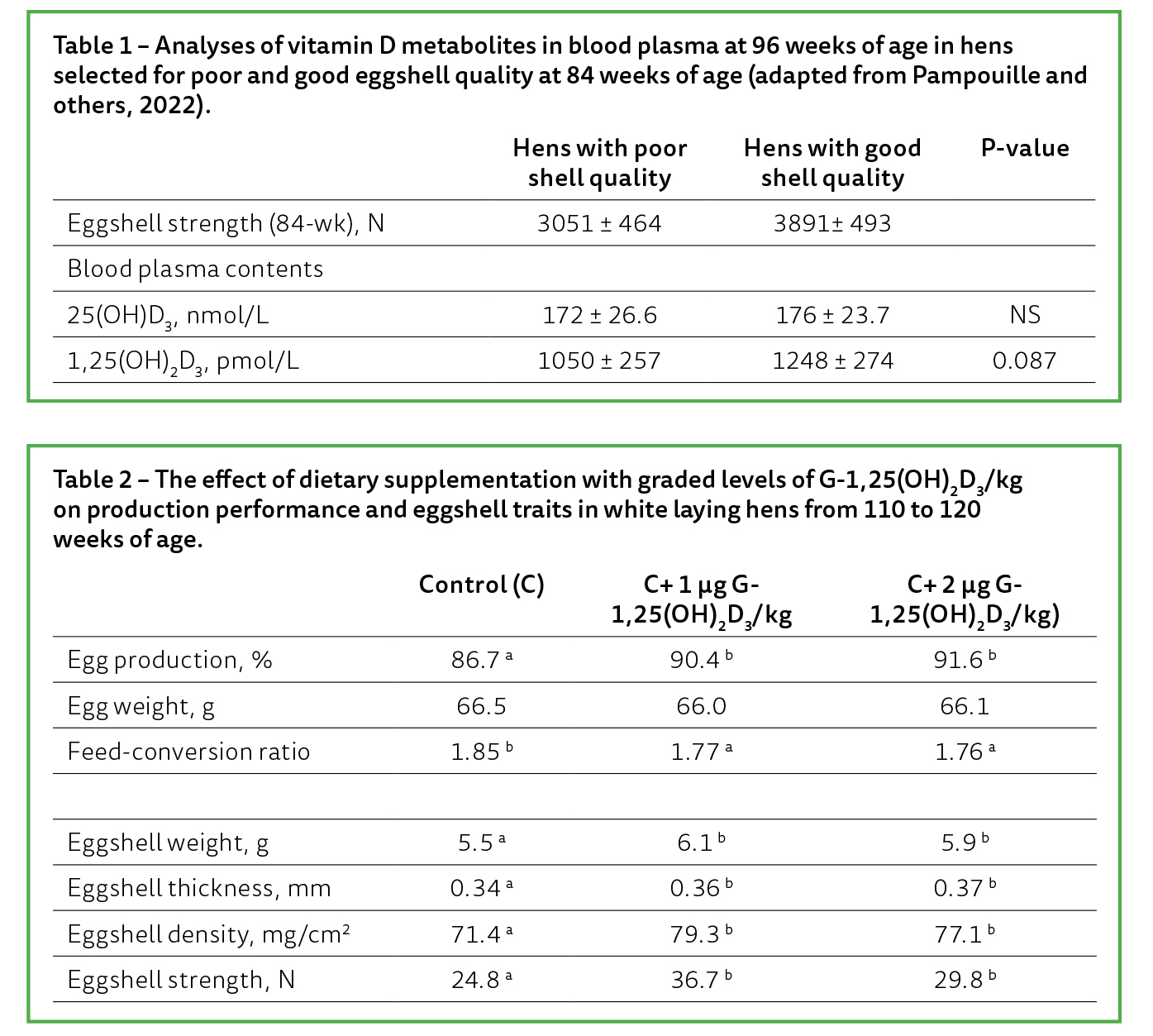
Recently, it was shown that this phenomenon still occurs in modern breeds. Pampouille and others (2022) selected hens with high and low eggshell strength from a group of brown laying hens at 84 weeks of age and analysed the concentration of vitamin D metabolites in the blood. They observed no difference in 25(OH)D3 in the blood, while the content of 1,25(OH)2 D3 was 20% lower in the hens with poor eggshell strength (Table 1).
This observation corroborates with Abe and others (1982) who indicated that older hens apparently cannot efficiently activate 25(OH)D3 , even when the circulating levels of 25(OH)3 in the blood are adequate. Alternatively, plant-based 1,25(OH)2 D3 in glycosidic form (G-1,25(OH)2 D3 ) can be used to compensate for this lack of 1-hydroxylase in the kidneys. Where the glycosides are hydrolysed in the gut, G-1,25(OH)2 D3 becomes a slow-release source of 1,25(OH)2 D3 which can directly stimulate calcium homeostasis, irrespective of the reduced activity of 1-hydroxylase. There are a few plants that naturally produce G-1,25(OH)2 D3 , of which Solanum glaucophyllum is known to have the highest level of glycosilation. Standardised Solanum glaucophyllum meal is an effective and safe way to supplement animal feed and support the mineral metabolism in animals.
Solanum glaucophyllum meal
An experiment was conducted in 2022 at UNESP (Brazil) with white LSL-Lite laying hens from 110 to 120 weeks of age. The hens were fed a maize-soya diet with 3.8% Ca, 0.39% available P (including phytase matrix) and 2’700 IU vit D3 /kg. At the start of the trial, a number of productive hens were selected and randomly allocated to one of three treatments (Control (C), C+ 1 μg G-1,25(OH)2 D3 /kg and C+ 2 μg G-1,25(OH)2 D3 /kg). Panbonis 10 (Herbonis Animal Health GmbH, Switzerland) was used as the source of the standardised Solanum glaucophyllum meal. Production performance and eggshell traits were measured during the 10-week trial period. (Results given in Table 2.)
Dietary supplementation with 1 μg G-1,25(OH)2 D3 /kg from Solanum glaucophyllum meal from 110 to 120 Vitamin D is key to maintaining calcium and phosphorus homeostasis in the laying hen and to support eggshell quality weeks of age improved laying rate and feed-conversion ratio. Doubling the dose only showed a marginal additional effect. Egg weights were slightly lower in the supplemented groups but were not significantly affected. Eggshell traits were all improved, again with the lowest G-1,25(OH)2 D3 inclusion level showing the best increase. The trial clearly demon- strates that the supply of 1,25(OH)2 D3 glycosides from Solanum glaucophyllum meal supports calcium metabolism and eggshell quality in laying hens.